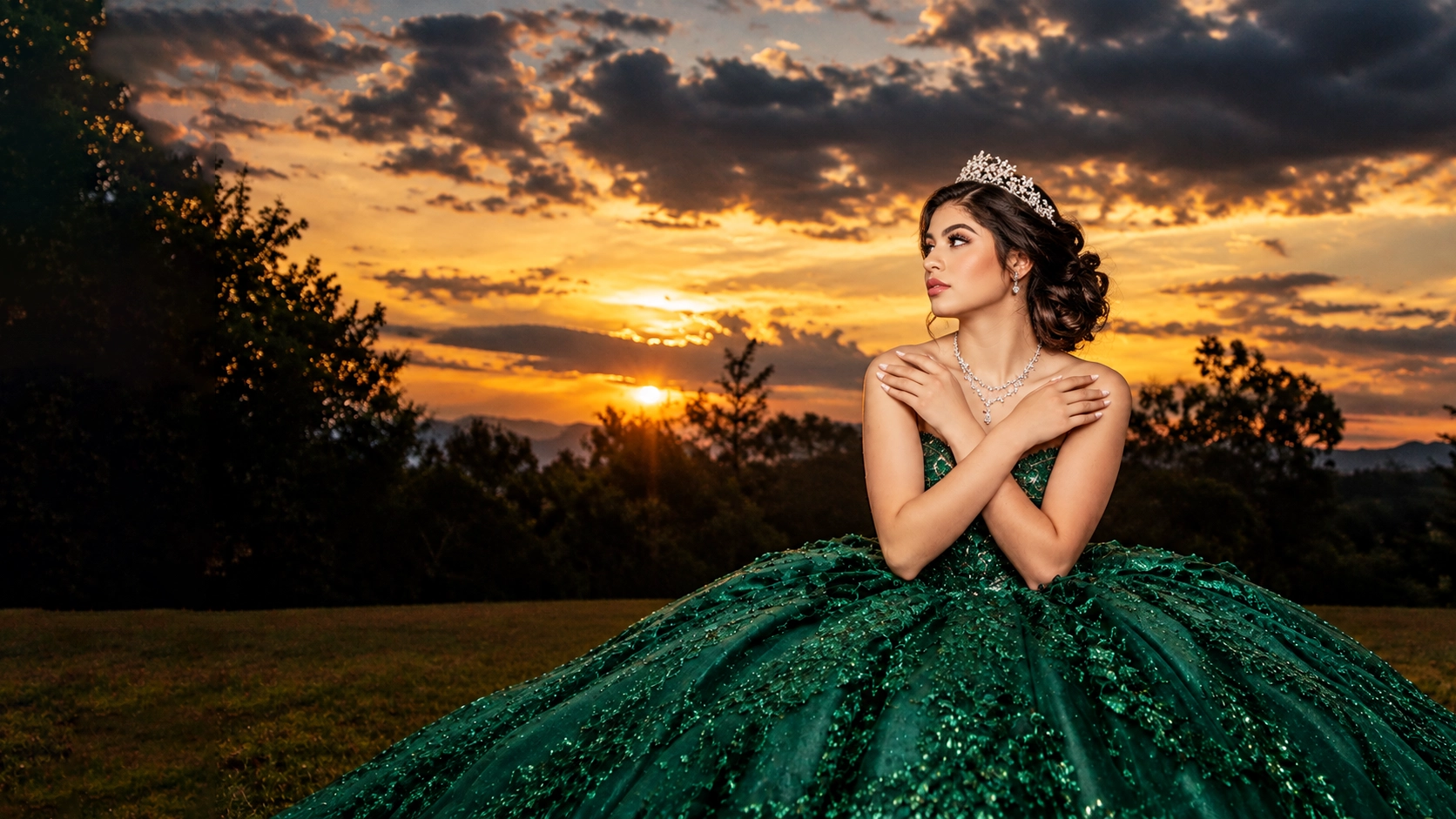
There is a moment in almost every quinceañera portrait session when the girl stops thinking about the camera.
It almost never happens at the beginning.
At first, she knows exactly where I am standing. She thinks about her hands. Her smile becomes something she is doing rather than something that simply appears. Her mom may be watching nearby. The dress is new. The makeup is finished. And suddenly there is a camera pointed directly at her.
For many girls, this is the first time they have ever been photographed this deliberately.
Then, little by little, something changes.
She understands what I am asking.
Her shoulders relax.
She stops asking where to put every hand.
Eventually, instead of arranging every photograph myself, I can say something as simple as, “Walk over there.”
And she knows what to do.
That progression is one reason the question studio or outdoor? is more interesting than it first appears.
These are not just two different backgrounds.
They create two different kinds of portrait sessions.
Studio vs. outdoor quinceañera photos: what actually changes?
The simple version is this:
Studio photography gives us control. Outdoor photography gives us movement and environment.
But even that is too simple.
In the studio, I control the light, background, position and visual distractions. I can make very small changes and see exactly what they do.
Outside, I give up some of that control in exchange for space, architecture, trees, pathways, wind, changing light and the possibility of photographs that feel less arranged.
Neither is automatically more natural.
Neither is automatically more elegant.
And neither is right for every girl.
The better choice depends on how she responds to being photographed, what kind of images the family wants, and how much unpredictability everyone is comfortable accepting.
What a studio quinceañera session feels like
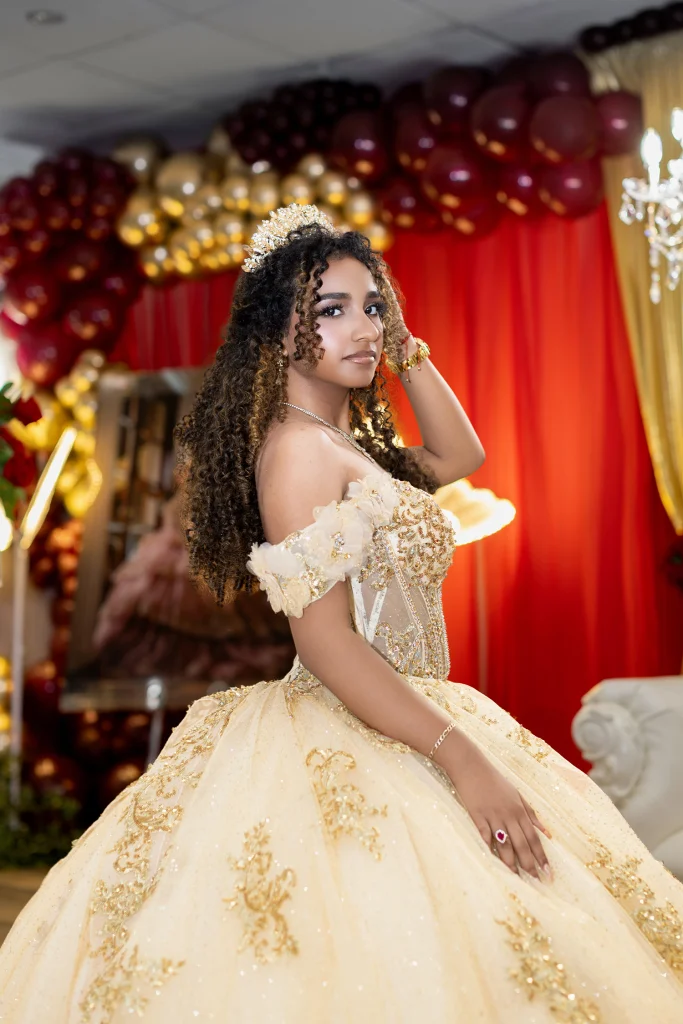
A studio makes everything intentional.
The background is chosen.
The light has a direction.
I can move that light a few inches and change the shape of the face, the shadow on the dress or the feeling of the entire portrait.
There is nowhere for the photograph to hide.
My direction becomes more precise too.
Turn slightly.
Bring your chin down.
Relax that hand.
Move your shoulder toward me.
Look into the light.
Now look away.
Studio photography is built from small decisions.
Sometimes a few centimeters matter.
That precision can make a girl more aware of herself at first. She may suddenly be thinking about things she never thinks about in everyday life: her hands, her shoulders, the angle of her face.
But I’ve noticed that repetition can create confidence.
Once she understands why I am asking for those little adjustments, they stop feeling strange.
She begins to occupy the space differently.
That is usually when the strongest studio portraits start appearing.
Studio portraits tend to be quieter
When I work in the studio, I often make photographs where relatively little is happening.
And that is the point.
A close portrait of her face.
The crown.
Details in the dress.
A carefully shaped silhouette.
A portrait where almost everything has been stripped away except the person, the clothing and the light.
The studio is particularly good when we want that kind of concentration.
There is no tree competing for attention.
No bright car somewhere in the background.
No wind suddenly rearranging the hair.
No sun moving behind a building while we are trying to finish a photograph.
The environment stays still enough for us to pay attention to subtle things.
Studio may be a good fit if:
- She likes polished, carefully composed portraits.
- The family wants close photographs of the face, dress, crown or other details.
- She responds well to clear direction.
- Weather certainty and physical comfort are important.
- You want the visual emphasis primarily on her rather than on a location.
But control has a personality of its own.
For some girls, the studio helps them become confident.
Others need space.
And you can often see the difference the moment we step outside.
What changes when we go outdoors
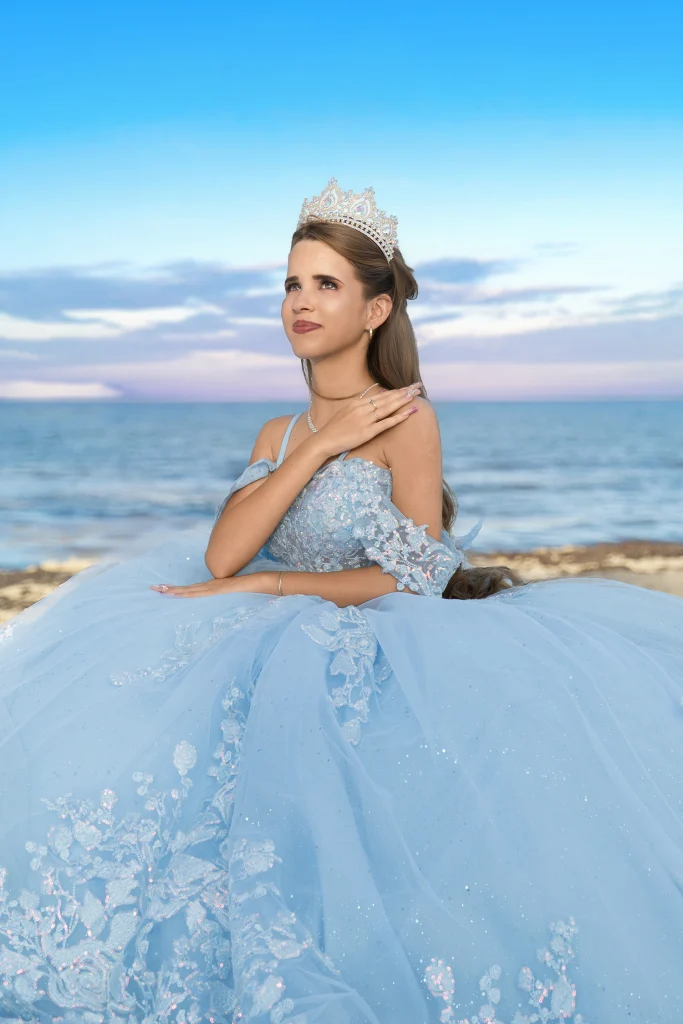
Outside, the relationship between the girl and the camera changes.
The first thing I usually notice is movement.
Suddenly there is somewhere to go.
A pathway.
A staircase.
An archway.
A row of columns.
An open area.
The dress begins reacting to the surroundings before she has time to think about posing.
That gives me a different way to direct.
Instead of telling her exactly where every part of her body should go, I can give her an action.
Walk toward me.
Turn.
Pick up part of the skirt.
Look back.
Walk through that opening.
Stop there for a second.
A small but important thing happens when a person has something to do:
She has something to think about besides the camera.
The hand holding the dress no longer looks like a hand that was carefully placed there. It has a reason to be there.
Hair moves.
The skirt opens.
Expressions happen between instructions.
And sometimes my favorite frame is not the photograph I asked her to make.
It is the second immediately afterward.
The laugh after the pose.
The glance toward her mother.
That instant when she assumes the photograph is already over.
Outdoor photographs can give the dress room to move
A quinceañera gown is not ordinary clothing.
It takes up space.
Sometimes quite a lot of it.
It has weight. Layers. Movement.
It changes how the girl walks and where we can comfortably photograph her.
That matters outside.
A location that works perfectly for someone wearing jeans can become completely different once we introduce a full quinceañera gown.
Narrow paths may become awkward.
Grass may slow us down.
Stairs require more care.
Long distances suddenly feel longer.
But give the dress enough room and something wonderful happens.
She walks and the dress follows.
She turns and it expands.
She stops and the fabric settles around her.
At certain points I’m not just directing the person anymore.
I’m directing the dress too.
That is one of the things outdoor photography can do especially well.
The location becomes part of the portrait
I also tend to work farther away outdoors.
That allows the environment to enter the photograph.
Architecture can create something structured and elegant.
Trees and open space can soften the image.
A long walkway can create depth and movement.
Late sunlight can change the mood without changing anything about the person.
But this is where outdoor sessions become more complicated.
You are no longer photographing only the girl.
You are also photographing the weather.
The light.
The heat.
The humidity.
The wind.
The distance from the car.
The amount of time before sunset.
And South Florida has opinions about all of those things.
South Florida heat changes a session
Heat may be one of the easiest things to underestimate when planning outdoor quinceañera portraits.
A family sees a beautiful location.
I see the beautiful location too.
But I’m also thinking:
How far is it from the car?
Where is the shade?
How long will she be standing in direct sun?
How heavy is the dress?
How long can we realistically photograph here before discomfort begins showing in her face?
A gown can have multiple layers of fabric. There may be elaborate hair and makeup. Add South Florida humidity, and walking several hundred feet can become part of the production.
That is why I don’t automatically think more locations equal a better session.
Sometimes they simply create more traveling.
If we spend a significant part of a two-hour session parking, walking, getting back into the car and rearranging the dress, we are using some of the girl’s best energy without making photographs.
I would rather work deeply in a couple of strong areas than rush through five.
Humidity matters even when it isn’t visible
Rain is obvious.
Humidity is quieter.
But it changes things.
Hair responds to it.
Makeup responds to it.
Fabric responds to it.
People get tired more quickly.
That means I think about the order of the photographs, not only the locations.
Early in the session, while everything is fresh, we may concentrate on cleaner portraits and close photographs.
Later, once she is comfortable and the session has loosened up, we can introduce more walking, turning and movement.
There isn’t a rigid rule that says a session has to happen this way.
It is simply an acknowledgment that a person wearing a quinceañera dress outside in South Florida has a physical experience of the session.
Comfort eventually appears in a photograph.
Bright sunshine isn’t always easy photography light
A perfectly sunny afternoon sounds wonderful until someone has to stand in direct midday light and look toward it.
Strong overhead sunlight can create shadows around the eyes.
People squint.
Light-colored pavement and buildings can reflect huge amounts of light.
And a bright quinceañera gown can become one of the most reflective things in the scene.
That doesn’t mean we cannot photograph during the day.
It means I start looking for the light before I look at the background.
A covered walkway.
The side of a building.
An archway.
A large tree.
Sometimes the best place to make the photograph is ten feet away from the place everyone initially thought was the prettier background.
That is one of the strange things about photography.
Families naturally see places.
Photographers begin seeing what the light is doing to those places.
Wind can ruin a portrait—and make a better one
Wind is less predictable.
Hair moves across the face.
A large skirt suddenly becomes difficult to manage.
Fabric refuses to stay where we placed it.
And then, a few seconds later, that same wind opens the dress perfectly.
Hair lifts.
The fabric gains shape.
The portrait suddenly has energy.
So I don’t always fight the wind.
Sometimes we wait for it.
Sometimes we turn.
Sometimes she holds part of the dress.
Sometimes I make the photograph specifically because the wind interrupted the photograph I thought I was making.
Outside, accidents occasionally become the picture.
Rain means the plan has to be flexible
South Florida also teaches photographers not to treat the weather forecast as a contract.
Conditions can change quickly.
A threatening afternoon can open into beautiful light.
A clear afternoon can suddenly produce rain.
That is why I don’t like building an outdoor session around one photograph that can only exist if everything happens exactly as imagined.
We plan.
But the plan needs room to move.
Covered architecture becomes valuable because it gives us somewhere to continue working.
Clouds can soften difficult light.
A location may not work, but another nearby area may work beautifully.
Preparation matters outdoors.
So does accepting what the day actually gives us.
If you want sunset portraits, arrive before sunset
Families often talk about sunset as though it were a location.
“We want sunset pictures.”
I understand exactly what they mean.
But sunset is not somewhere we can arrive late and expect to find waiting for us.
The useful light changes quickly.
And its timing changes across the year. In Palm Beach County, for example, summer sunsets can occur after 8 p.m., while the evening light shifts substantially earlier during other parts of the year.
Buildings, trees, clouds and the direction of the location can shorten the usable window even further.
If sunset photographs matter, I want the quinceañera comfortable, dressed and already in position before the light becomes what we are waiting for.
The final minutes are not the time to be looking for parking.
Light doesn’t wait.
What about photographs with parents?
This is something I think families should decide before the session.
Photographs with parents can be extremely important.
They also take time.
A girl alone can move quickly from one idea to another.
Add parents or siblings and the rhythm changes.
Someone adjusts clothing.
Someone is looking in another direction.
Mom notices something about the dress.
Someone asks where to put a hand.
That is completely normal.
But those photographs deserve their own time rather than whatever minutes happen to remain at the end.
If family portraits matter, tell your photographer in advance.
Then they become part of the session instead of an interruption to it.
Which looks more natural: studio or outdoor quinceañera photos?
This is where I disagree with the idea that outdoor automatically means natural and studio automatically means posed.
Photography is more complicated than that.
A studio portrait can be carefully constructed and still reveal enormous confidence.
An outdoor portrait can look spontaneous even though I chose the exact position, direction, light and moment that allowed the spontaneity to happen.
Every portrait contains some construction.
What matters more to me is whether the girl still recognizes herself inside it.
That is the part I watch for.
Some girls become confident in the studio
Give them a place to stand, controlled light and clear direction, and you can watch their confidence build.
The structure helps.
They know what I want.
They see the results.
They begin understanding how small movements change the photographs.
Eventually, they are no longer waiting nervously for the next instruction.
They are participating.
For that personality, the studio can be liberating precisely because it is controlled.
Other girls come alive outdoors
Then there are girls who change the moment we leave four walls.
They need movement.
They need space.
They need something other than a camera to think about.
Instead of asking them to create an expression, I can let an expression happen while they walk.
Instead of arranging the dress perfectly and asking them not to move, I can allow the dress to become part of the movement.
They stop feeling as if they are posing.
That difference can be visible almost immediately.
Can you combine studio and outdoor quinceañera portraits?
Yes, when there is enough time and when both settings are actually contributing something different.
I would not combine them simply because “more” sounds better.
Studio and outdoor portraits work well together when there is a reason for both.
The studio can give us controlled, deliberate portraits and details.
Outside can give us scale, environment and movement.
That contrast can create a more varied final collection.
But combining them also introduces travel, outfit logistics and more time.
In South Florida, it may also mean planning around heat or sunset.
So the decision should begin with the photographs you want—not with the number of locations you can fit into the session.
Studio or outdoor: how should your family decide?
If you are planning your first quinceañera portrait session, I would think about five things.
Think about her personality.
Does she enjoy being carefully directed, or does she relax more easily when she can move?
Think about the photographs you are drawn to.
Are they clean, close and controlled—or environmental, spacious and full of movement?
Think honestly about comfort.
Heat, humidity, walking and a heavy gown are not minor details during an outdoor session.
Think about time.
Multiple locations, family photographs and sunset all use part of the same clock.
Think about what actually matters to her.
Not every quinceañera wants the same photographs her parents want, or the same photographs another girl posted online.
The session should leave enough room for her personality to become visible.
There isn’t one correct choice
I could make a list declaring studio photography elegant and outdoor photography natural.
It would be neat.
It would also be wrong.
Studio can be expressive.
Outdoor can be formal.
Studio can create confidence.
Outdoor can make someone self-conscious.
A girl can look completely like herself under carefully controlled studio light.
Another can need a path, some wind and twenty feet of open space before she forgets I am holding a camera.
That is why I don’t think the real decision is between four walls and an outdoor location.
The decision is about how she wants to be photographed.
A quinceañera portrait session happens at an unusual age.
We are photographing someone while her sense of identity is still moving quickly, and then asking her to look composed and confident in front of a camera.
Sometimes she arrives knowing exactly what she wants.
Sometimes she has poses saved on her phone.
Sometimes she is shy.
Sometimes her mother has stronger ideas than she does.
And sometimes she simply needs twenty minutes before the session begins to feel like hers.
That part matters more than whether there is a tree or a backdrop behind her.
Because somewhere between the carefully shaped studio portrait and the photograph of a dress moving through an open space, I am looking for the same thing:
The point where she stops asking what she is supposed to do.
And starts becoming comfortable with being seen.
Planning a quinceañera portrait session in South Florida?
David Studio photographs quinceañera portrait sessions in studio and outdoor settings, with the session shaped around the girl, the location and the kind of photographs your family wants to create.
If you’re deciding between studio, outdoor or a combination of both, tell me what you’re imagining. We can figure out which setting makes the most sense before choosing a session around it.
Leave a Reply